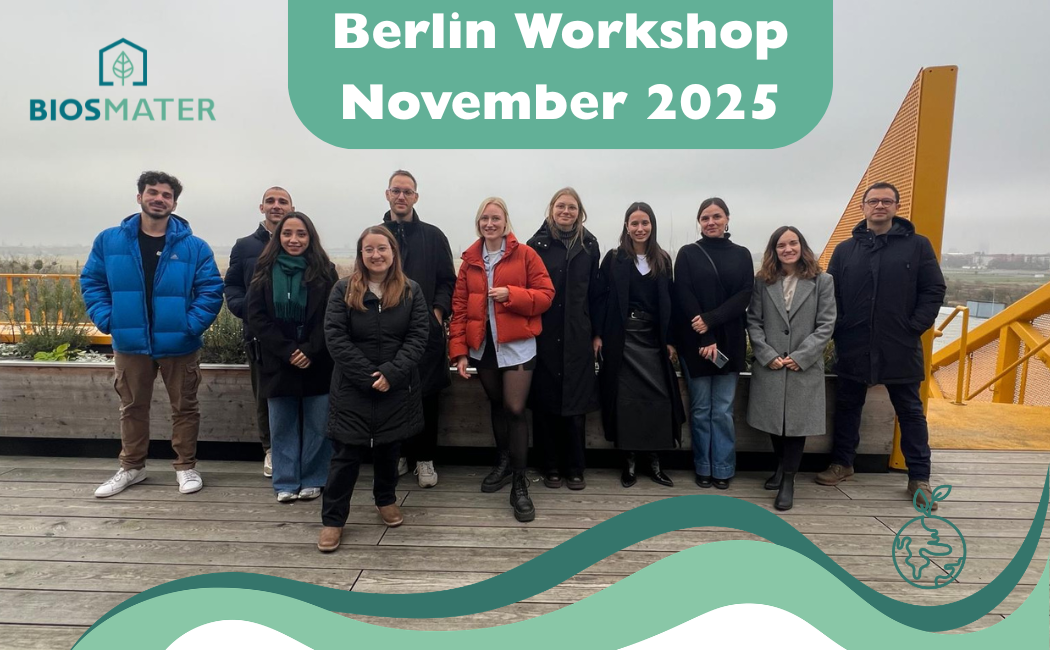
In November 2025, the BIOS MATER consortium gathered in Berlin for a two-day stakeholder workshop dedicated to co-creation and collaborative problem-solving. Hosted by Bauhaus Earth, the workshop marked an important milestone in the development of BIOS MATER’s innovative bio-based building products.
Working with bio-based materials means navigating new and often complex territory. Many emerging products require entirely new testing approaches, while regulatory pathways depend on parameters that are still being defined. At the same time, there is no ready-made roadmap for bringing these materials to market. Addressing these challenges requires more than technical expertise alone—it requires collaboration across disciplines and sectors from the earliest stages of development.
For this reason, co-creation sits at the heart of the BIOS MATER approach. As Georg Hubmann from Bauhaus Earth explained during the workshop:
“With different stakeholders working on feedstock, design, testing and road to market, no single project partner sees the full picture. Co-creation is how we make sense of it together.”
Throughout the two-day session, consortium partners worked alongside external practitioners to align perspectives and build a shared understanding of key challenges. Discussions focused on defining common terminology, clarifying regulatory questions, and identifying the performance requirements that bio-based construction materials must meet to succeed in real-world applications.
External experts contributed valuable insights from their experience in product development, certification processes, and architectural practice. Their contributions reinforced an important message heard repeatedly throughout the workshop: early dialogue between researchers, industry professionals, and designers can significantly reduce risks later in the innovation process.
The Berlin workshop strengthened the collaborative foundation of the BIOS MATER project and reaffirmed a key lesson for the bio-based construction sector: co-creation is not simply a collaborative exercise, it is a prerequisite for transforming promising ideas into safe, high-performance, and market-ready sustainable building solutions.